Explained · no equations
Before reheating
A short account of what we compute, why it matters and what has come out so far. The long read with charts and the interactive 3D model are linked at the bottom.
Black holes instead of invisible particles
About 85 % of the matter in the Universe does not shine and does not interact with light. We see this dark matter only through its gravity. It is usually sought as a new kind of elementary particle, but there is another candidate that needs no new particle physics: primordial black holes (PBHs). They could have formed not from stars but directly from overdensities in the first fractions of a second after the Big Bang.
Observations have already ruled out many PBH masses, but for asteroid masses — 10¹⁹–10²⁰ grams, holes roughly the size of an atom — they still allow PBHs to be all of the dark matter. The question is whether the early Universe could have made enough of them.
The dust era
After inflation, space may have been filled for a while by a heavy scalar field — the inflaton itself or another field. It oscillates about its minimum, and on average these oscillations behave like a gas of very heavy particles with no pressure. Cosmologists call this "dust", and the epoch the dust era, or the early matter era. Later the field decays and the Universe fills with hot radiation; that moment is called reheating.
Dust is a generous environment for black holes. In a hot Universe, radiation pressure disperses overdensities, and only very strong ones collapse into holes. Dust has no pressure: any overdensity keeps growing until the expansion lets go of it, and then it falls in on itself.
Threshold and deadline
Dust has a catch: the collapse is slow. A weak overdensity takes a long time to collapse, and the dust era does not last forever. If reheating comes before the overdensity becomes a hole, radiation pressure stops it.
So the main question of the project is a single number: the threshold μth(D). It is the smallest amplitude μ of the initial curvature peak for which a horizon forms before reheating at time D. We measure time in units of tH, the moment the peak "enters the horizon", i.e. becomes causally connected. The deadlines we consider are 100, 300 and 1000 tH. The lower the threshold, the more holes form from the same seed from inflation: in the rare tail of the distribution, halving the threshold gains orders of magnitude.
Dust versus a swarm of particles
The fall of ideal dust has an exact solution — Lemaître–Tolman–Bondi (LTB). In it, the spherical shells of the overdensity fall to the centre like the layers of an onion and never pass through each other. The first shell reaches the centre at time tC(0), and a horizon appears right away.
A real field cannot do that. We describe it as a swarm of collisionless particles: the Einstein–Vlasov equations, the same ones used for stars in galaxies, but in full general relativity. The particles do not stick together at the centre; they fly straight through and come back, like a pendulum. A multi-stream core builds up around the centre, and the horizon closes only once that core is compact enough. Why particles and not the field itself? For asteroid-mass holes the field oscillates 10⁹ times faster than the Universe expands, and in that limit it is indistinguishable from a swarm of particles. A direct field calculation at affordable frequencies gives quite different physics — we checked: the core bounces before it can become a hole.
What the calculations show
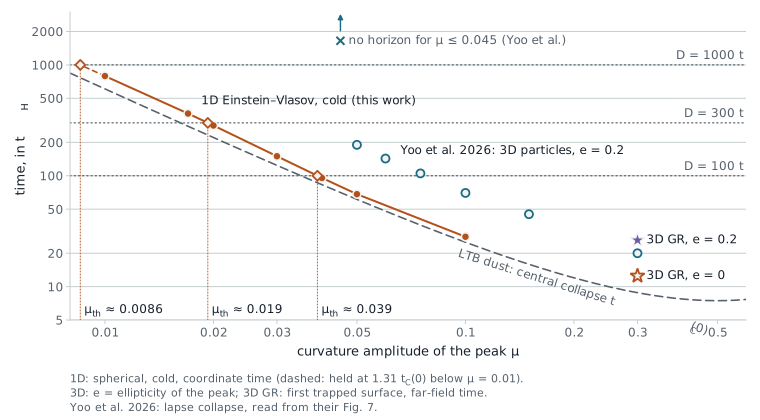
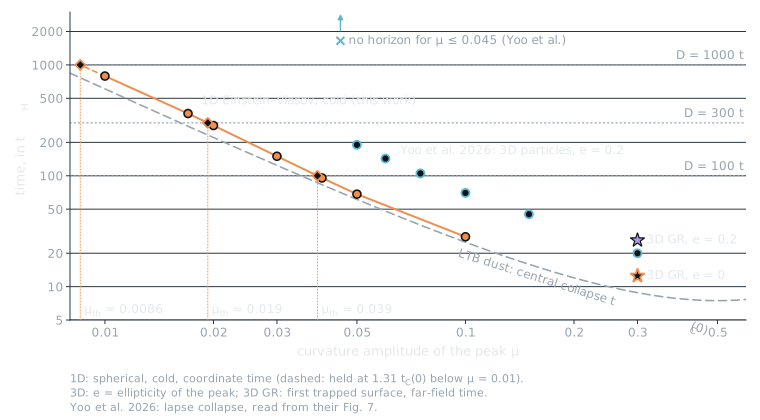
Spherical. With spherical symmetry the particle swarm forms a horizon 12–30 % later than ideal dust, but it does form one — down to the weakest overdensities we tested (μ = 0.01). That gives the thresholds μth ≈ 0.039 for a 100 tH deadline, 0.019 for 300 tH and 0.0086 for 1000 tH. Trusting them took many checks: on a coarse grid the core seemed to set a "floor" to the threshold, but it was a numerical artefact.
What can get in the way. A real field carries small-scale ripples. If they shake the particles to ≈ 3 % of the speed of light by the time the overdensity turns around, no spherical holes form at μ ≤ 0.05 by 300 tH. The shape of the peak matters too: a steep peak assembles more slowly than a Gaussian one. So the threshold depends strongly on the details of the initial spectrum, and only three-dimensional calculations can give the final answer.
Three dimensions. We wrote our own Vlasov particle module for a 3D general-relativity code with adaptive meshes and tested it step by step: a homogeneous Universe, the exact LTB solution, horizon growth. For a spherical peak the 3D run matched the exact solution and the 1D code to better than 1 %. Then came the first non-spherical peak (ellipticity e = 0.2, μ = 0.3). It collapses in turn: first into a "pancake", then a "filament", and only then does the third axis contract. The horizon appears almost twice as late as for a sphere (by the clocks of the infalling matter), but it is massive from the start — about one Hubble mass.
What next
Weaker non-spherical peaks, μ = 0.1 and 0.05, are being computed now: do they make the 100–300 tH deadlines? If they do, the threshold for realistic peaks will be close to the spherical one and asteroid-mass PBHs remain a dark-matter candidate; if not, the seed needed from inflation grows by orders of magnitude. Each such run takes about a day on an 8-core server.
Further reading
- Long read "Before Reheating" The full popular story with charts: dust and particle swarms, the threshold map, dispersion, profiles, 3D. Snapshot of 7 October.
- A PBH seen from a particle (3D) Interactive model: the collapse seen by a dust grain, and a random field fragment whose peaks become PBHs.
- Results The same story with numbers, tables and figures for specialists.
- Computation log Everything step by step: every run, every bug found and fixed.