Summary as of 8 October 2026
Results
What has been computed, how accurately, and what follows from it. Every number traces back to the computation log, which describes the runs, convergence checks and bugs found.
Key findings
| Question | Answer | Status |
|---|---|---|
| Cold spherical collapse threshold in GR (Vlasov) | μth(100) ≈ 0.039, μth(300) ≈ 0.019, μth(1000) ≈ 0.0086; no floor down to μ = 0.01 | converged |
| How much later than dust the horizon forms | 1.12–1.31 tC(0), growing towards small μ | converged |
| Effect of velocity dispersion | small (σ ≤ 0.01) speeds it up by 6–13 %; kicks of ≈ 0.03 c at turnaround remove PBHs at μ ≤ 0.05 within 300 tH | mapped by source |
| Effect of the profile shape | first order, through how synchronously the shells collapse | 3 profiles |
| Non-sphericity, Newtonian 3D | the third axis collapses 1.7–2.7× later than a sphere → μth(100) ∈ [0.039, ~0.06–0.08] | estimate |
| A scalar field instead of particles (GRChombo) | the core bounces (Kaup limit), no horizon | closed |
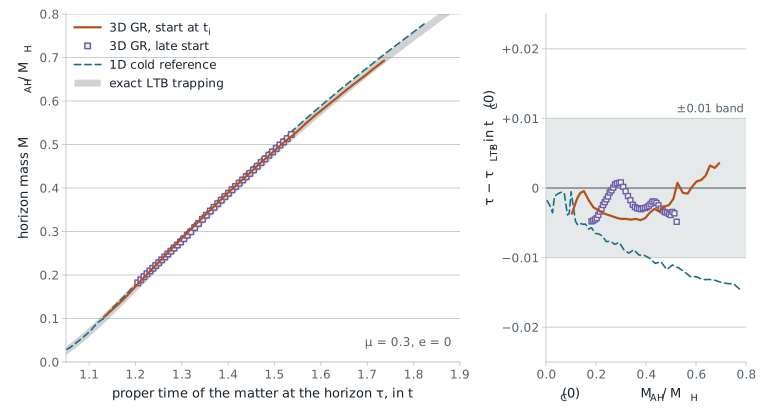
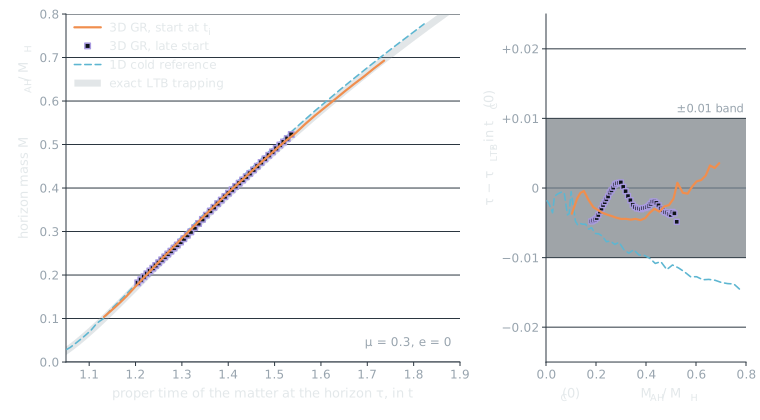
| 3D GR with particles, e = 0 | horizon growth matches LTB and 1D to ±0.01 tC(0) | passed |
| 3D GR with particles, e = 0.2, μ = 0.3 | horizon of ≈ 1 MH at τ = 2.09 tC(0) (sphere: 0.1 MH at 1.13) | obtained |
| μ = 0.1 and 0.05 at e = 0.2 and 0.13 | — | running |
Spherical collapse (1D)
Code: pbhgr/cosmo_ev.py — spherical Einstein–Vlasov in the areal gauge with CMC slicing K = −3H(t) and a shift, horizon-penetrating and fully constrained (equations in Appendix B of the plan). Initial data: the long-wavelength CMC data of Yoo et al. (2026), pbhgr/cosmo_id.py; reference: the exact LTB solution, pbhgr/ltb.py.
Code checks
- A homogeneous Universe (FLRW) is reproduced to 10⁻⁹; the LTB cycloid to 1.7·10⁻⁴ at 0.8 tC, with second-order convergence.
- Causal-bound test at μ = 0.36: every shell is trapped at its LTB tAH to 10⁻⁴.
- A static Einstein–Vlasov polytrope stays static to ~10⁻³.
- Convergence in the grid (K = 2000…8000, re-stretched spacing dR = 0.3/k → 0.15/k) and in the number of shells per cell (4…64): at small μ the multi-stream core suffers discreteness relaxation, which saturates at ≥ 32 shells per cell (≈ 1000 shells in the core).
- Independent check of the horizon diagnostic with the
sphdiagmodule (the PBH-VERIFY-01 pilot): the resolved horizon appears 0.29 tH after the formal criterion at μ = 0.10 — a ~1 % effect.
Threshold map (cold case)
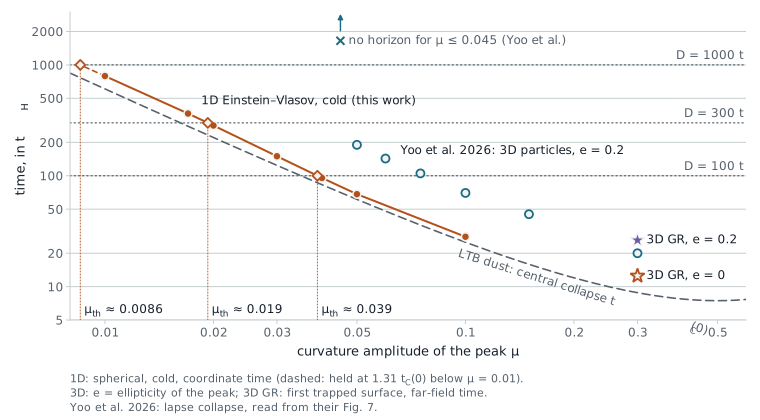
| μ | tC(0), tH | first horizon, tH | / tC(0) |
|---|---|---|---|
| 0.10 | 25.1 | 28.2 | 1.12 |
| 0.05 | 61.2 | 68.3 | 1.115 |
| 0.04 | 83.0 | 95.5 | 1.15 |
| 0.03 | 124 | 150 | 1.21 |
| 0.02 | 221 | 284 | 1.28 |
| 0.017 | 280 | 364 | 1.30 |
| 0.010 | 607 | 793 | 1.31 |
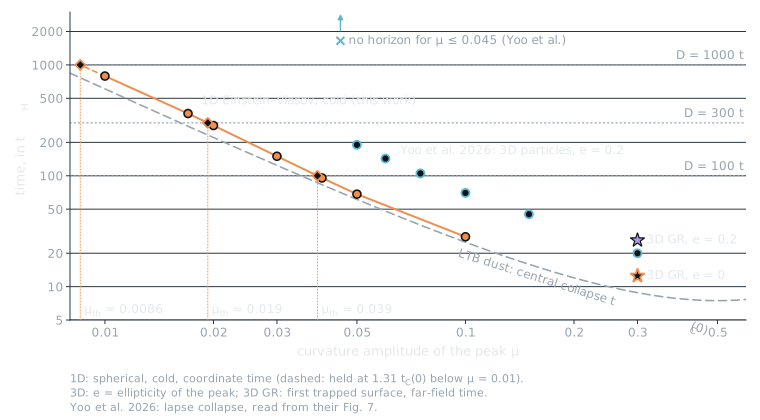
Thresholds where the curve crosses the deadlines: μth(100) ≈ 0.039, μth(300) ≈ 0.019, μth(1000) ≈ 0.0086. The first horizon is tiny (0.001–0.02 MH) and grows: at μ = 0.1, 0.1 MH is trapped by 1.43 tC(0) and 0.3 MH by 1.92.
For comparison: in the 3D particle runs of Yoo et al. at e = 0.2 there is a horizon for μ ≥ 0.050 and none for μ ≤ 0.045 within their ≈ 250 tH. The spherical map gives a horizon by ~80 tH at μ = 0.045, so the absence of a horizon in Yoo et al. at that amplitude is an effect of non-sphericity (or run length), not of the spherical threshold. The μ = 0.1 and 0.05 runs at e = 0.2 test this directly.
Velocity dispersion
A real field is not perfectly cold dust: it has a velocity dispersion (de Broglie, σent = √6/q at horizon entry) and kicks from small-scale structure that switch on during the collapse.
| Source | Amplitude | Result |
|---|---|---|
| Dispersion at entry, σent ≤ 0.01 | q ≳ 250 | horizon 6–13 % of tC(0) earlier than cold (μ = 0.04: 88–90 instead of 95.5 tH) |
| σent = 0.03 | q ≈ 80 | same as cold |
| σent = 0.1 | q ≈ 25 | 1.15–1.33 tC(0); μth(100) ≈ 0.040–0.044, μth(300) ≈ 0.02 |
| Harada (2023), release at ρvir | σv ≈ 0.17 c at ρ = 10³ ρent | shift ≤ 1.5 % of tC(0) — switches on too late |
| Ebrahimian, k/k₀ = 30 | ≈ 0.003 c at turnaround | μth(100) ≈ 0.040, μth(300) ≈ 0.025 |
| Ebrahimian, k/k₀ = 10 | ≈ 0.01 c | μth(100) ≈ 0.045, μth(300) ≈ 0.028 |
| Ebrahimian, k/k₀ = 3 | ≈ 0.03 c | no horizon at μ ≤ 0.05 within 300 tH |
Conclusion: a threshold floor is set by the kick amplitude times the time it switches on. A later release (bnl = 0.6 and 0.3) shortens the delay. The cold "no floor" result is fragile against realistic small-scale power — the decisive test is 3D with a real spectrum.
Profile shape
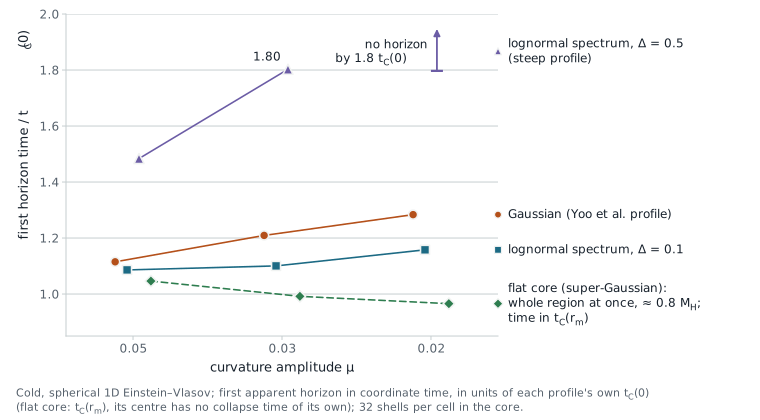
| μ | Gaussian (Yoo) | lognormal Δ = 0.1 | lognormal Δ = 0.5 | super-Gaussian flat core |
|---|---|---|---|---|
| 0.05 | 1.115 | 1.09 | 1.48 | ≈ 1.0 tC(rm), 0.8 MH at once |
| 0.03 | 1.21 | 1.10 | 1.80 | same |
| 0.02 | 1.28 | 1.16 | none by 1.8 | same |
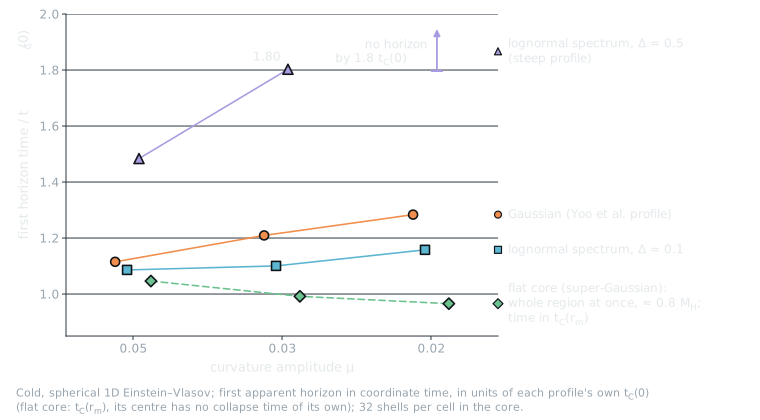
The profile shape is a first-order effect: it controls how synchronously the shells fall. A flat core collapses as a whole; a steep peak assembles slowly. With σ = 0.03 the lognormal Δ = 0.1 is unchanged (1.110) and Δ = 0.5 is delayed by another 12 %.
Non-sphericity: semi-analytics and Newtonian 3D
The Bond–Myers ellipsoid model for ν = 4 peaks: the median ellipticity e = 0.13 gives the pancake at 0.91 and the last axis at 1.05 of the spherical collapse time; the 90th percentile e = 0.19 gives 0.85 and 1.09. In this model non-sphericity shifts the threshold by at most 3 %.
A Newtonian particle-mesh code (pbhgr/pm3d.py, N = 192³, 7M particles) showed that this is a strong underestimate:
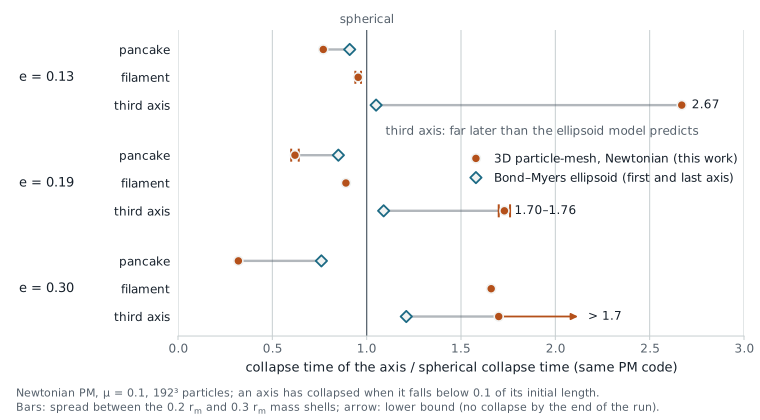
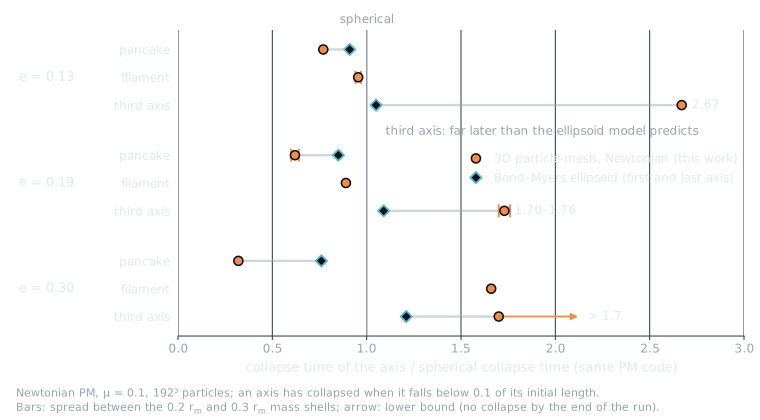
The third axis collapses 1.7–2.7× later than the sphere. The horizon must appear somewhere between the filament stage (~0.95) and the third-axis collapse, hence μth(100) ∈ [0.039, ~0.06–0.08]; the 0.045–0.05 of Yoo et al. falls inside. With a small-scale tail in the spectrum (ζ = 0.05, k = 2–10), one of three random fragments breaks up and the other two build one dominant clump. Only 3D GR can narrow the bracket.
3D GR with a scalar field (GRChombo)
Stage 1: does a coherent scalar field in 3D give the same horizon as the 1D map at e = 0? A PBHCosmo example for GRChombo (adaptive meshes, 5 levels, box 8 rm), μ = 0.1, m tH = 30.
The result is a bounce: the central density reached 1739 times the background at the caustic and fell to 0.3 by 1.9 tC(0) — the core emptied and no horizon formed. The reason: the Kaup mass 0.633/m = 0.028 MH exceeds the first-horizon mass in 1D (0.016 MH warm, 0.001 cold). At affordable m tH the field behaves like a boson star, not like dust. A scalar 3D calculation would need m tH ≥ 100–300 (3–10× the cost) and still could not see the tiny first horizon. Hence stage 2 — Vlasov particles in 3D.
3D GR with particles (PBHVlasov)
Stage 2: our own Vlasov particle module PBHVlasov for the GRTeclyn code (AMReX, CCZ4): deposition on all AMR levels, geodesic motion with each particle's proper time, a gauge referenced to the K profile, ray and sphere horizon diagnostics.
| Step | Check | Accuracy |
|---|---|---|
| FLRW, dust | homogeneous expansion | 0.2–0.3 % |
| LTB, e = 0, μ = 0.3, geodesic slicing | shell radii to 0.96 tC(0) | 0.2–0.5 % |
| AMR deposition | FLRW on two levels | locally exact (1.0000) |
| Production gauge | shells by proper time and mass label | ≤ 0.5 % to τ = 0.96 |
| Horizon growth (lapse coefficient 2, to 2.2 tC(0)) | MAH(τ) against LTB and 1D | ±0.004 and ≤ 0.012 tC(0) over 0.09–0.58 MH |
| Warm particles, σ = 0.0272 | horizon growth at M ≥ 0.18 MH | unchanged (0.1 % delay) |
Stage 1b: early start and non-spherical peaks
To compute non-spherical peaks, the run starts early, at ti, from Yoo's long-wavelength data for any ζ(x): the matter is built from the constraints; geodesic slicing is used until 0.5 tC(0), then 1+log slicing (coefficient 2) with a Γ-driver; the time step follows the expansion. Two systematics with an O(dt/t) lag were found by the FLRW test and fixed; the particle density is matched to the constraint density to ~10⁻⁵, because the binding energy 2E at a super-horizon start is a small difference of large numbers.
Check at e = 0 (7 levels, 20 h on the CCX33): the early start matched the late start to 0.007 tC(0) and LTB to 0.010 in the proper time of the matter at the horizon, for M = 0.11–0.6 MH.
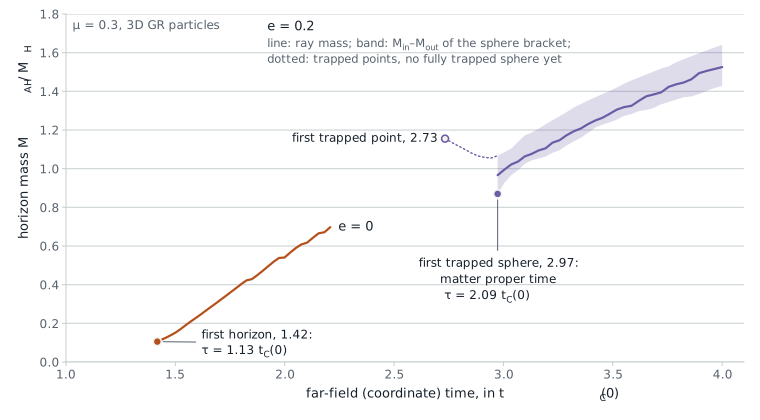
e = 0.2, p = 0, μ = 0.3:
| time tfar / tC(0) | M inner / MH | M outer / MH | Rmin/Rmax | τ of the matter |
|---|---|---|---|---|
| 2.73 | first trapped point | |||
| 2.974 | 0.87 | 1.07 | 0.81 | 2.09 |
| 3.256 | 1.10 | 1.27 | 0.94 | 2.38 |
| 3.552 | 1.27 | 1.44 | 0.99 | 2.64 |
| 3.965 | 1.42 | 1.63 | 0.94 | 2.97 |
The non-spherical peak collapses in turn — pancake, filament, third axis — and the horizon appears only at τ = 2.09 tC(0), but straight away with ≈ 1 MH, about the mass a spherical horizon would have grown to by then. At first it is clearly non-spherical (Rmin/Rmax = 0.8) and rounds off to 2–6 % within 0.5 tC(0). At e = 0 the horizon was born tiny (0.105 MH at τ = 1.13).
In Yoo et al., at the same μ and e, the lapse collapses at ≈ 20 tH = 2.27 tC(0). Our far-field times (2.73 and 2.97) refer to a different slicing, and their criterion is the lapse, not a trapped surface; the invariant statement of our run is τ = 2.09 tC(0) for the matter of the first trapped sphere.
What next
- The warm first horizon and kicks from small-scale power in 3D (a real spectrum instead of a single mode).
- Peak statistics: from μth(D; e, p) to the fraction β and fPBH, with the distribution of e and p at ν ≈ 4.
- A higher-resolution check; a request to the Yoo group (V0) to extend their particle runs to 500–1000 tH.